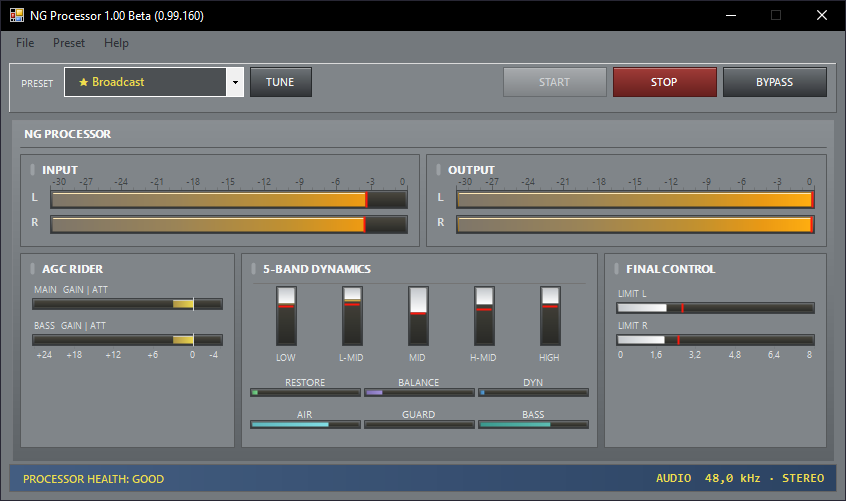
NG Processor levels, shapes and protects a station's audio the way a reference-class hardware processor does - and then gets out of the way. A windowed AGC with real upward room, a five-band section that adds glue rather than density, restoration for tired masters, and a clean look-ahead true-peak final stage.

The rider works around a floating window: small musical movement passes untouched, real level errors are corrected slowly and calmly. What makes it a radio AGC is the room it has to work with - and what it does when the next track starts on top of a lifted fade.
The multiband section rides a few decibels of gain reduction on dense material and leaves the station's loudness to the final stage. Common-mode calm stops the five bands from moving together on the beat; a shared low-frequency budget keeps the bass guards honest.
Crossovers at 100 / 400 / 1600 / 6400 Hz. Each band has its own threshold, ratio, attack, release breakpoint and clip-error control; the band output mix is the station's tonal colour knob.
An 18 dB/oct LF contour gives weight; a clean pre-limiter and a deep peak guard share one reduction budget so the loudest bass note never comes out softer than its neighbours.
Three-band parametric EQ, a program-aware presence lift and a second-order air shelf with its own guard. The factory Reference voicing is matched to a reference-class hardware processor within a decibel across the spectrum.
Corrects sources that are persistently dull or bright over many seconds, with deadbands, sudden-change protection and persistence so artistic colour changes are left alone.
Crest-gated, band-aware restoration returns punch to flattened masters within a bounded budget, without touching material that is already dynamic.
Headroom-governed stereo enhancement with mono bass, a speech/music detector with its own multiband personality, and an optional de-esser.
Loudness-war masters, hiss in the pauses, hum and line whistles from old transfers: the restoration stages run in front of the AGC, so nothing downstream has to work around damage.
Flat-topped peaks are reconstructed, optionally with a spectral deep-restore pass, guarded by a confidence law so natural flat crests are never "repaired".
Six-band floor-tracking expander: a few decibels less hiss in pauses and tails, nothing touched that is clearly above the noise floor, no musical-noise artefacts.
Mains hum with harmonics, the 15.625 kHz line whistle and a 19 kHz pilot are notched only when detected, and only as deep as needed.
Sample-peak and true-peak ceilings are met by a look-ahead limiter with a sliding-minimum gain envelope, an oversampled clipper for the last fraction of a decibel and a crest shaper for broadcast density. Adaptive distortion guards back the chain off the moment the audio would start to sound processed.
Sample ceiling and inter-sample true-peak ceiling are separate settings, so streaming and FM chains get exactly the margin they need.
The clipper works oversampled with overshoot compensation; band-limited error control keeps low-frequency clip products out of the mix.
Output is identical for 64- or 4096-sample blocks, exactly symmetrical for identical channels, exactly zero on silence, and the reported latency is accurate to one sample.
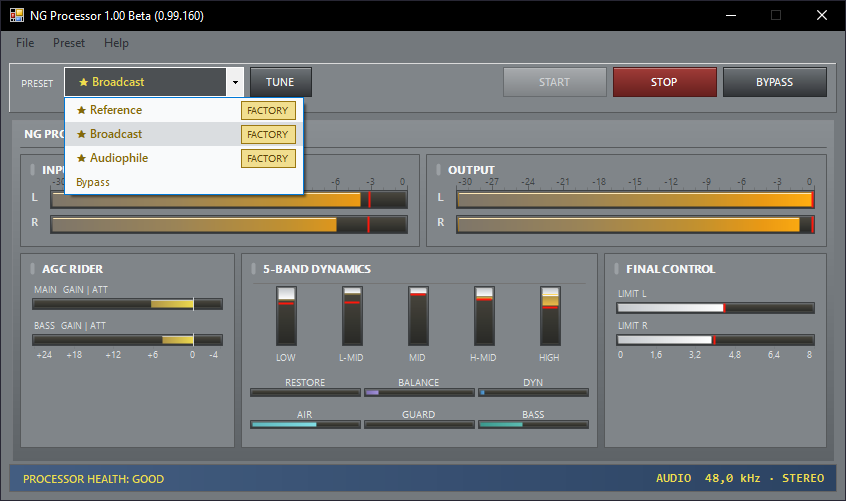
Presets are JSON files in the Presets folder next to the executable. Factory presets carry a certificate and show a ★ FACTORY badge; edit one and it simply becomes yours. No rebuild, no proprietary format, no lock-in.
Calibrated against a reference-class hardware processor. The clean, neutral basis every other personality is built on.
Radio flow: +16 dB AGC room, quiet-intro reserve, hot re-acquisition, mid/high punch and a light crest shaper.
No AGC, no bass processing: restoration, natural dynamics and gentle tonal normalisation for listening.
Built in. Every stage off; the final limiter only guards against overload. Starts even with an empty presets folder.

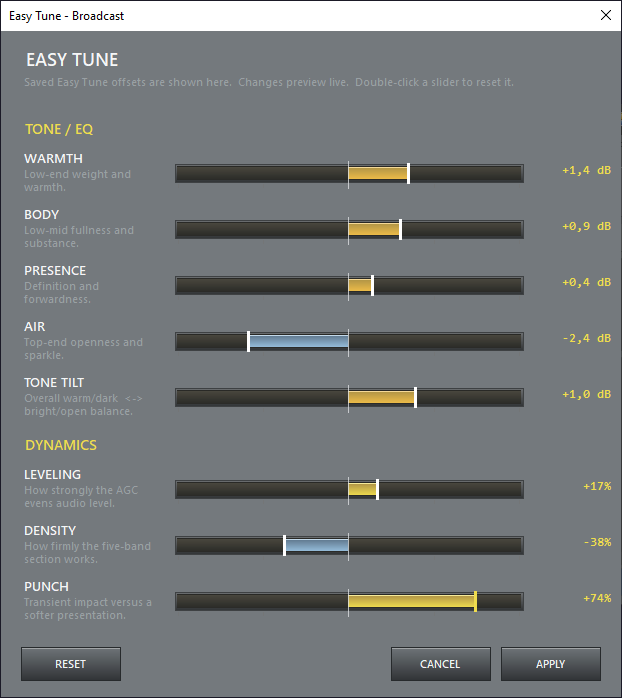
Warmth, Body, Presence, Air and Tone Tilt shape the sound in 0.1 dB steps without touching detector calibration. Leveling, Density and Punch are bounded macros for the three dynamics decisions an operator actually makes. Changes preview live; zero is exactly the preset.

Run it live on a WASAPI input and output, process WAV files offline with identical results, or load the same engine as a plugin inside NG Encoder - reading the same preset files.
Input reference level and line-up correction are set once; the preset never has to be re-tuned for a different source level. Parameter changes are cross-faded into the live chain with the slow control states carried over.
Process a WAV with the current preset. Offline and real-time paths are verified to render identical audio.
Drop the plugin next to NG Encoder and pick a preset in the host. Factory presets keep their star there, too.
The complete manual is part of the website: quick start, main window, settings, presets as files, Easy Tune, the AGC in depth, meters and health, file processing, the NG Encoder plugin, troubleshooting and a commissioning checklist.
Open the HTML manual →